
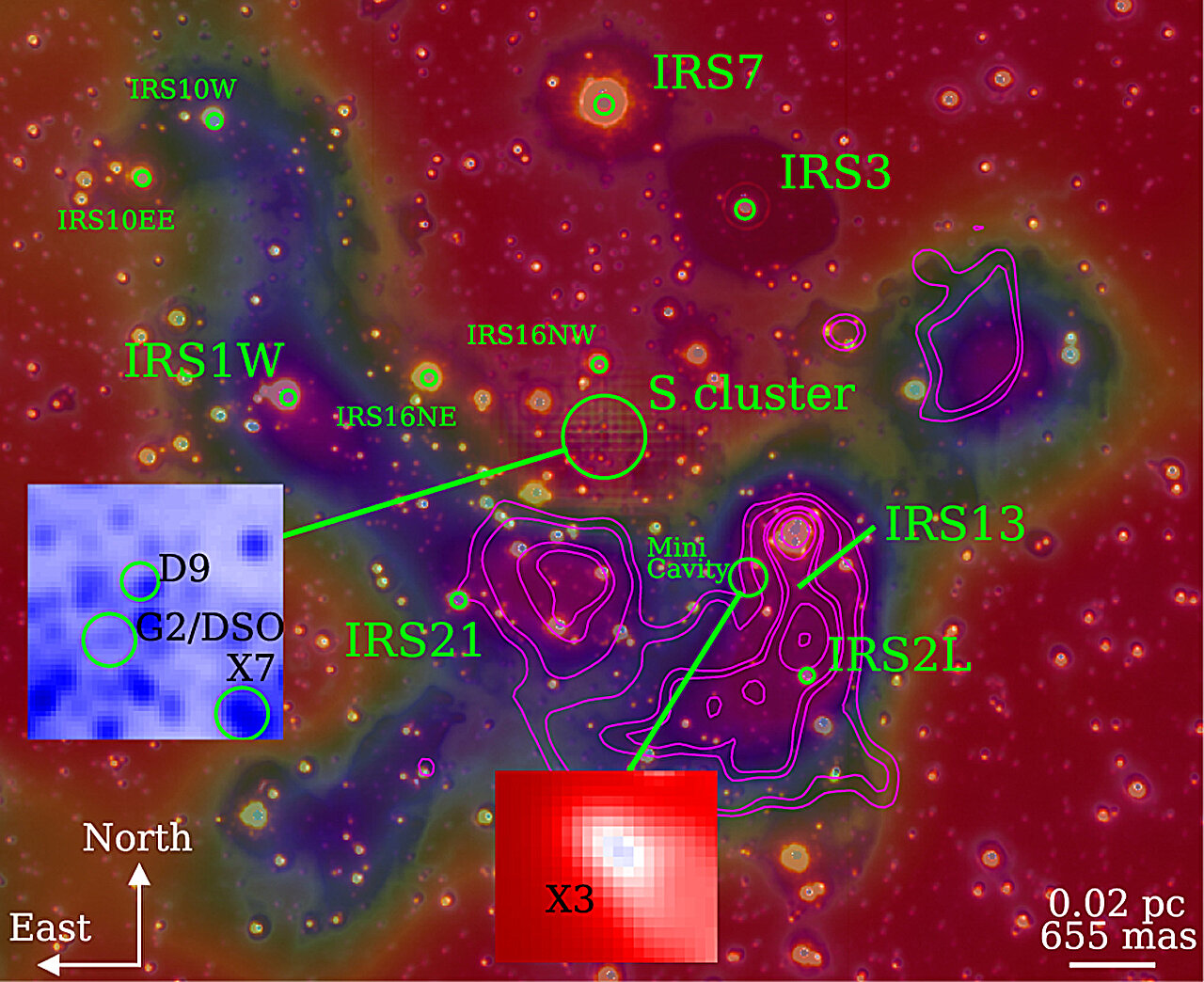
Astounding Discoveries Around Sagittarius A*
An international research team, headed by PD Dr. Florian Peissker at the University of Cologne, has utilized the state-of-the-art Enhanced Resolution Imager and Spectrograph (ERIS) at the Very Large Telescope (VLT) in Chile, to make revolutionary observations of the supermassive black hole at the heart of our galaxy, Sagittarius A*. Their findings have revealed something quite remarkable: several dusty objects are maintaining stable orbits around this cosmic giant.
Diving Into the Heart of the Galaxy
The center of the Milky Way, marked by the presence of the supermassive black hole called Sagittarius A*, has been a subject of fascination and critical study for many years. Black holes, known for their extreme gravitational pull capable of engulfing everything including light, naturally raise questions about the stability and fate of nearby celestial objects.
The Role of ERIS in Unveiling Cosmic Mysteries
The ERIS instrument, a cutting-edge addition to the VLT, has been pivotal in allowing astronomers to observe these enigmatic dusty objects with unprecedented clarity and resolution. This powerful tool has provided critical data that shows these objects not only survive but thrive in stable orbits around the black hole.
Implications for Astrophysics
The data obtained through ERIS could challenge our current understanding of black hole dynamics and prove invaluable in studying how objects can endure and persist in such extreme environments. These findings could have profound implications for future theoretical physics and enhance our grasp of galaxy formation and evolution.
Conclusion
This remarkable study opens up new avenues for research into black hole environments and contributes significantly to our understanding of the complex dynamics at play in the heart of galaxies. The ability of dusty objects to maintain stable orbits around Sagittarius A* lends new insights into the resilience and behaviors of matter under extreme gravitational forces.