
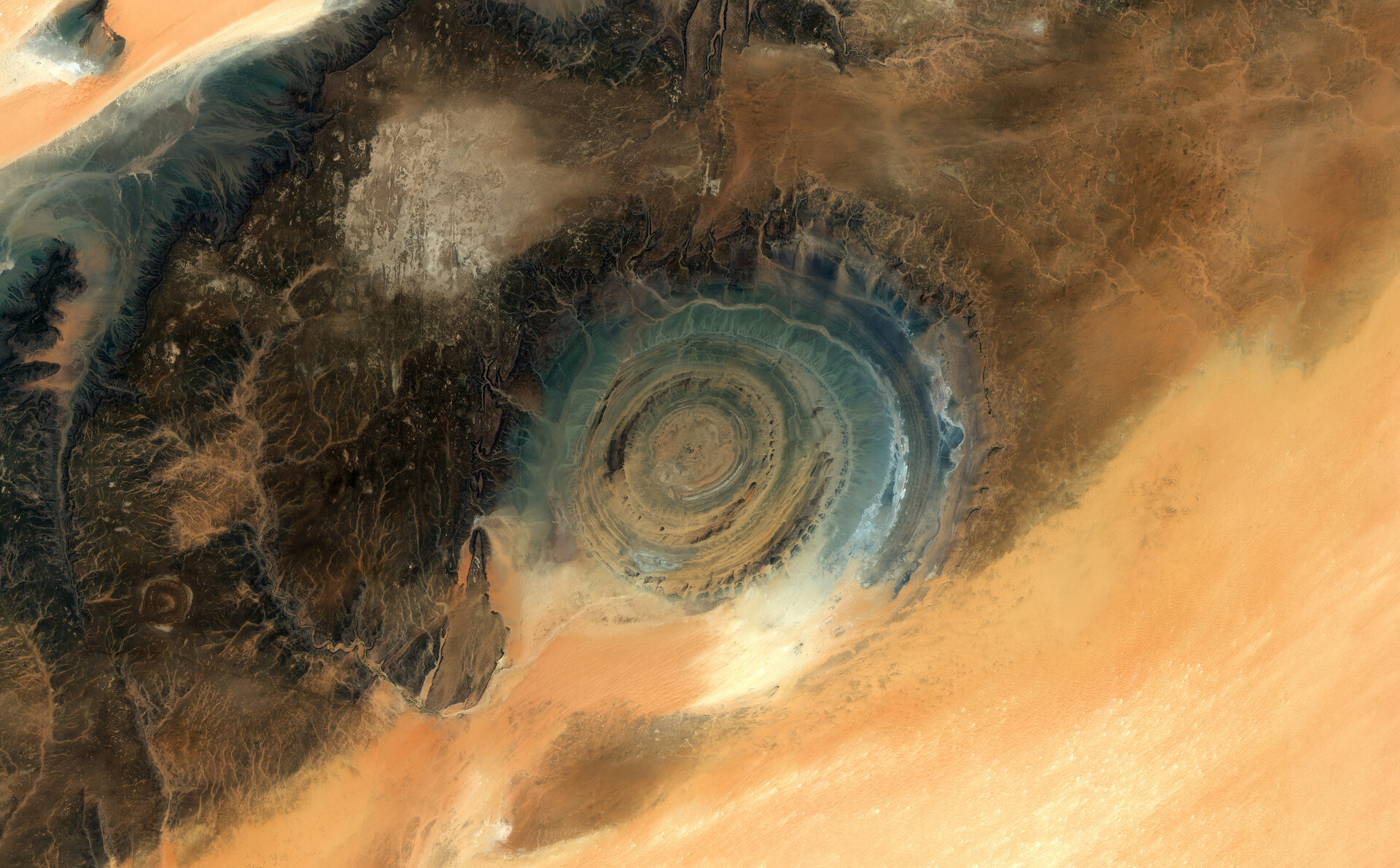
A Geological Marvel from Space: The Eye of the Sahara
The European Space Agency's (ESA) Copernicus Sentinel-2 mission has provided us with a mesmerizing view of one of Earth's most intriguing natural features. Known as the Richat Structure, but often referred to as the Eye of the Sahara, this striking geological formation stands out amid the expansive sands of Mauritania's section of the Sahara Desert.
Understanding the Richat Structure
This prominent circular feature has been a subject of scientific studies and theories since its discovery. Initially mistaken for a meteorite impact site due to its circular shape, the Richat Structure is now understood to be a deeply eroded dome with layered sedimentary rocks. Its various rings display a spectrum of colors, with each hue representing a different layer of rock that has been exposed over time.
Satellite Imagery Sheds New Light
The Copernicus Sentinel-2 mission utilizes high-resolution multispectral imaging technology to capture detailed photographs of Earth's surface. Through the eyes of Sentinel-2, the Richat Structure is revealed in unprecedented detail, allowing scientists and geologists to study its formation and continue unraveling its mysteries.
The Significance of the Richat Structure
Aside from its scientific interest, the Richat Structure has also captured the imaginations of storytellers and photographers from around the world. Its visually striking appearance from space makes it a popular fixture in satellite imagery collections and has contributed to various myths and legends. The structure is not only a geological wonder but also an artistic muse to many who marvel at its beauty from above.
Why Monitoring Earth's Geography Matters
Observations taken from the Copernicus Sentinel-2 mission contribute significantly to our understanding of terrestrial geography and geological activities. Monitoring landscapes like the Richat Structure helps scientists to predict geological changes, assess the impact of climate change, and support various environmental conservation efforts.
Conclusion
The continued observation of Earth's most fascinating geographical features by missions like ESA's Copernicus Sentinel-2 not only enhances our scientific knowledge but also reminds us of the planet's dynamic and evolving nature. The Richat Structure, with its layers of history and beauty, remains one of the many jewels in Earth's geological crown that continues to fascinate and inspire.